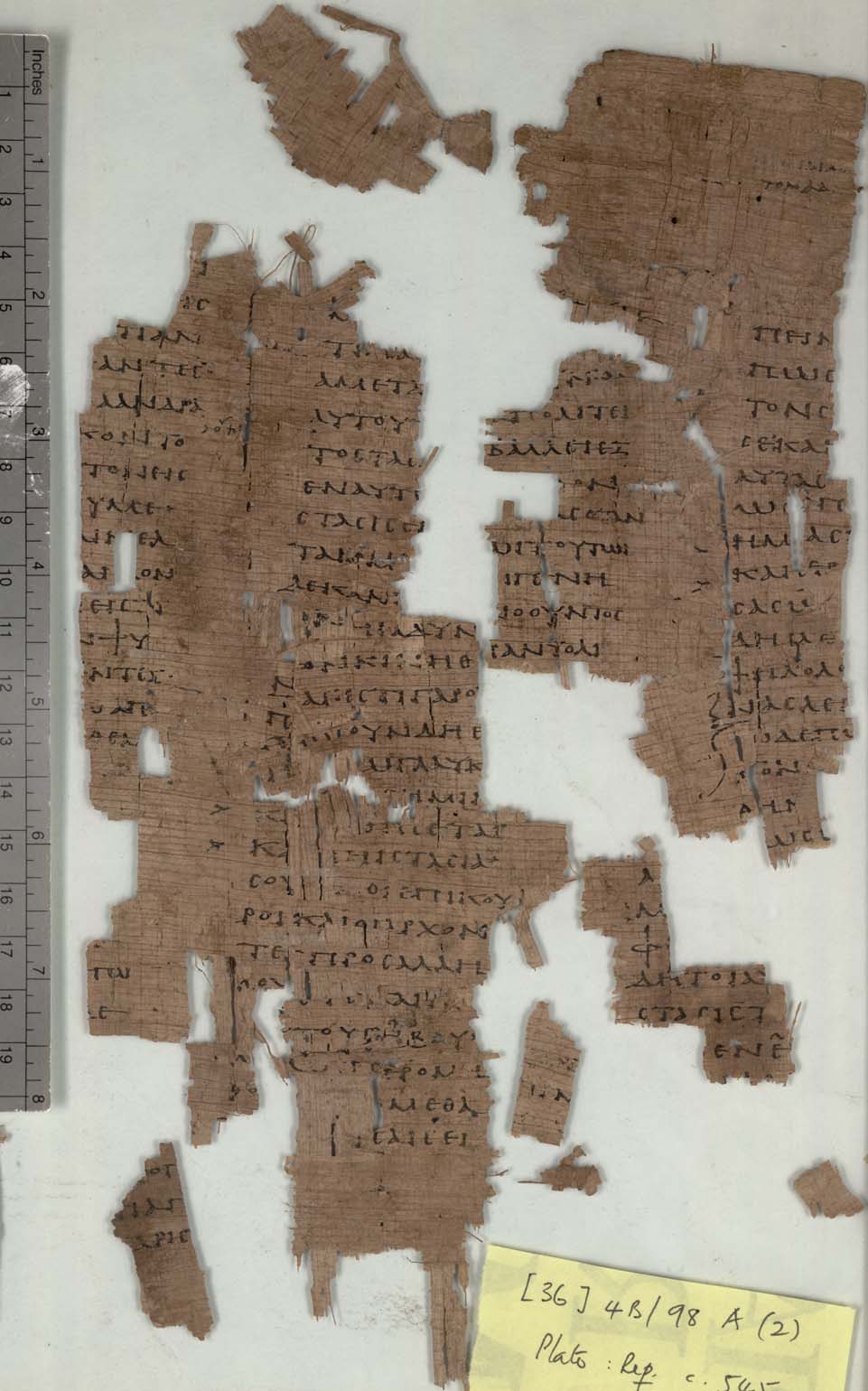
P.Oxy. XLVII 3326
| Edition | P.Oxy. XLVII 3326 |
|---|---|
| Inventory | Oxford, Ashmolean Museum 36 4B.98/A(2)a |
| Doctype | Lit. |
| Url | http://163.1.169.40/cgi-bin/library?a=q&r=1&hs=1&e=q-000-00---0POxy--00-0-0--0prompt-10---4------0-1l--1-en-50---20-about-3223--00031-001-0-0utfZz-8-00&h=ded&t=0&q=3326 |
| Provenance | Egypt, Oxyrhynchus |
| Archive | |
| Material | Papyrus |
| Format | Roll |
| Remarks | 3 cols.; the original roll, if it contained only this book, would had been 7 m long; space fillers |
| Recto\Verso | Written along the fibres |
| Content | Plato, De Republica 8.545c - 546a |
| Doc Date | AD02 |
| Date Criterion | Recto/Verso |
| Script | Careful formal bookhand of Severe style, upright, with contrast; numerous leftwards serifs |
| Paleographic Remarks | On the back a document, an account, apparently of expenditure on food-stuffs, written in a coarse hand of the 3AD (according to ed. pr.). De luxe manuscript |
| Lectional Apparatus | Dicolon, high and middle stop (in descending order of strength); acute and circumflex accents; rough breathing; coronis used to separated different sections; dicolon and paragraphos to mark change of speaker in the dialogue |
| Critical Signs | Diple |
| Abbreviations Symbols | ου(τωϲ) = sic, against a reading to indicate that it has been checked (whether against the exemplar or another copy) |
| Orthography | Elision not marked; iota adscript written |
| Corrections | |
| Annotations\Scholia\Glossae | Marginal note in the upper margin of col. 3, perhaps a sub-heading to a new section; abbreviated note against a reading (see Abbreviations); these annotations seem to have been written by another hand, in a script of smaller size and less calligraphic |
| Illustrations | |
| Plates | |
| Repertories | |
| Bibliography | |
| Other Remarks | For the use of the dicolon as mark of punctuation, which is unusual in literaty texts, cf. other Platonic texts: P.Oxy. II 229, V 843, VII 1016, XV 1808, 1809, XVIII2181, PSI XIV 1392; this particular articulation of puntuaction seems to be due to the syntactical complexity of Plato’s longer sentences. For the use of the coronis to divide the different sections cf. P.Oxy. V 843, VII 1017, XVII 2102. Diacritical marks are applied with economy and discrimination, in case of potential ambiguity. For the use of diple in Platonic texts cf. Diogenes Laertius 3.65 f. and an earlier, anonymous writer in Mélanges Tisserant i 25 - 30, but the use seems wider, according to P.Mil.Vogl. I 9 i 8, X 1248 115, XVII 2102 iii 1, 13, 16, 24, XXVII 2468 ii 9,22, iii 7,, XV 1809 iii 16) |
| Catalogues | LDAB 3791 Mertens-Pack 1420.1 TM 62606 |
P.Oxy. XLVII 3326